Wednesday, June 8, 2016

"The West End"

I did not realize until my recent travel to Tunisia that my experience of the Mediterranean has been disproportionately of the eastern end of this amazing region. I’ve walked the Mediterranean coast in Italy, Greece, Turkey, Lebanon, Israel, and Egypt. I’ve not experienced much of the 'west end' of this great sea or its diverse and ancient cultures. 
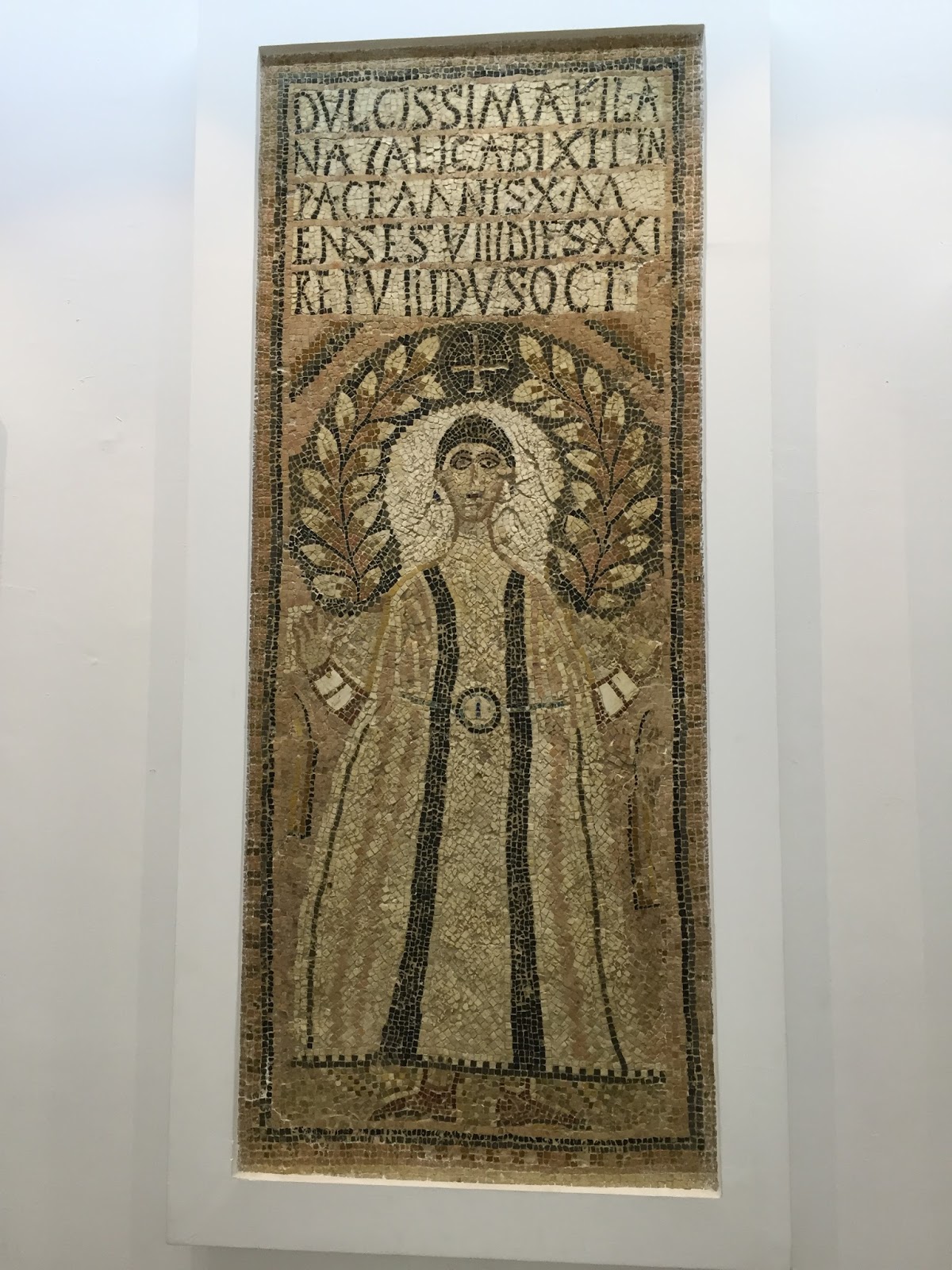
An early Christian grave - 5th century - Bardo Museum
I’m enough of a student of history to know something of the role of North Africa — today’s Libya, Tunisia, and Algeria — in the Greco-Roman world. This was the land of Hannibal, of Saints Cyprian and Augustine, of Tertullian and other Latin fathers of the early church. It is easy to forget in the modern world that Carthage, just north of modern Tunis, was one of the main centers of the early Christian church, as this church largely, if not completely, disappeared by the Middle Ages. 

Early Punic sculptures, showing Egyptian influence - circa 1000 BC
Yet there is abundant history before this, the history of the city of Carthage before its defeat and destruction by Rome 146 BC. Carthage was a Punic city, tracing its roots to Phoenician traders from what is now Lebanon at the dawn of the first millennium BC. Carthage presided over a rich and wide-spread Punic civilization that stretched across North Africa and into the Iberian Peninsula. A few remnants of this society can be seen in the archaeological sites of ancient Carthage, but most — including nearly all the written archives of this civilization — were lost in the final battle with Rome. The millions of Berbers/Kabyle who still live in Algeria, Morocco, and Tunisia (among other places) continue to trace their links to these ancient civilizations. 
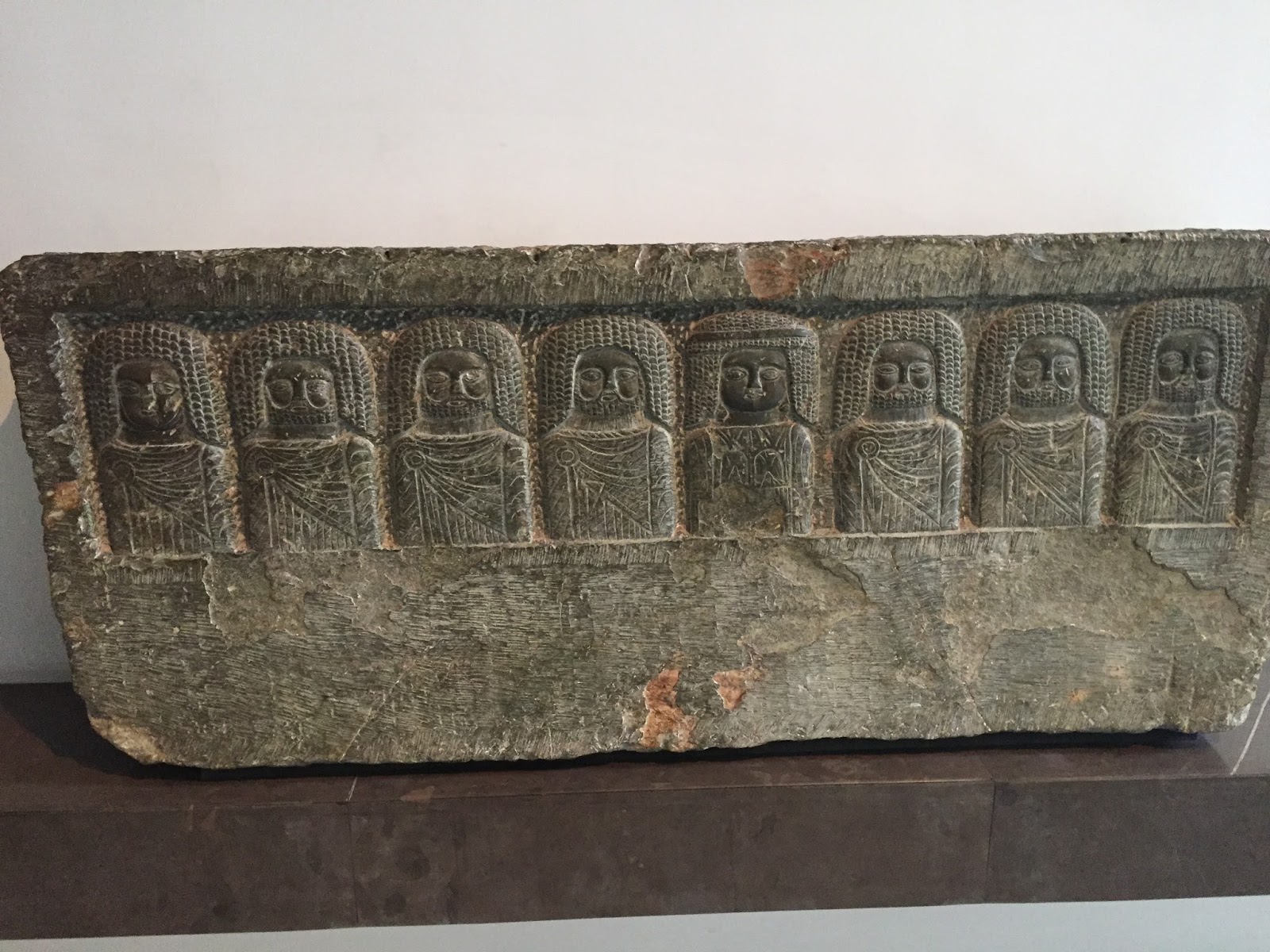
Pre-Roman deities - circa 200 BC - Bardo Museum
Carthage arose again as a Roman city, the gateway to the rich and fertile breadbasket of North Africa that provided great wealth to republican and imperial Rome. Christianity came early to the region. St. Cyprian presided as bishop of Carthage in the third century and was martyred there. Augustine wrote and stayed there (although one dare not raise the question today of whether Augustine was Tunisian or Algerian!). The council that affirmed the canon of the Bible was likely held there. 

Classical mosaics - 3rd century - Bardo Museum
Today, Carthage is a ruin. Unlike Athens or Rome or Jerusalem, which have had layers of civilization sprawling across them since ancient times, Carthage was largely abandoned until recent decades. Today, the Tunisian presidential palace stands on the hill overlooking the Mediterranean. The homes of the rich have clustered around it. At virtually every corner, however, is an archaeological site of Punic, Classical, or Christian Carthage. The view over the brilliant blue sea and the mountains of Cap Bon peninsula is stunning. 

Ruins of the Basilica Damous el Karita - probable site of early Christian councils

I’m reminded again how deep the well of history goes in this region. This trip certainly reminded me that there’s a ‘western’ end of this story of which I’ve known very little.  

The ruins of the Cathedral of St. Cyprian - Carthage with the Mediterranean and Cap Bon in the background

Tourism and Terrorism


This is my first visit to the North-African nation of Tunisia, a former French colony that gained its independence in 1956. The capital, Tunis, remains deeply influenced by France. While Tunisian Arabic is the language of the street, nearly everyone I’ve encountered speaks very good French as well. The presence of numerous street cafés, pâtisseries, and even the architecture of Tunis evoke an admixture of France, the Arab world, and Africa. 

A street in the Medina of Tunis - these types of doors are typical
Tunisia has, for the most part, been a very stable nation in a very unstable region. Despite this stability, tourism, which constitutes a significant part of the economy, has fallen significantly since the terrorist attacks on the Bardo Museum and the beachfront at Sousse in 2015, attacks in which more than 50 people died. Egypt, where I spent time earlier in this trip, is even more tourism dependent, and has seen an even greater fall in tourism since the Arab Spring. 

Travel always makes the theoretical very real. Distant headlines take on human form. This happened for me yesterday when I hailed a cab in central Tunis to travel to the Bardo Museum. It was cold and rainy, and I was not prepared for that kind of weather, so I made what I knew would not be the best financial choice and chose a cab parked along the main boulevard of the city. The driver, Mohammad, was a man around 60, who told me he had been driving a cab in Tunis for 38 years. As we drove for 20 minutes to the Bardo Museum on the outskirts of town, he told me of his love for his city, of many beautiful spots to see in and near Tunis. He also told me of his work on “18 mars,” using this date in March of last year in the way that Americans would use 9/11. He had met an Italian family at the cruise ship port near Tunis and was taking them on a day-long tour of the ancient city of Carthage, the Tunis Medina, and the Bardo (he could do the same for me for €60, he worked in!). As he drew near the the Bardo that day, there was an explosion and something was clearly very wrong. Several hours later, he returned his passengers safely to their cruise ship. They were to learn that several of their fellow passengers were among the 18 killed that day. He retained and showed me the work-order dated 18 March 2015. What struck me about the conversation was the way in which he articulated the sort of unbelief and disruption that this day raised, again not unlike Americans’ feelings about 9/11. These sorts of things were not and are not common in generally peaceful Tunis. It put an entire nation into a state of disequilibrium. 

A few of the amazing Bardo mosaics
The Bardo is magnificent, and is arguably now one of the most protected places on earth. Yet the truly sublime museum of Carthaginian, Phoenician, and Greco-Roman art was nearly empty for most of my visit. Galleries stood dark, the café was closed, and the bookstore seemed to have a few too many books in German. Many of the stewards showed great pride in the truly amazing collection, as well as in the expanded museum structure that involved majestic modern architecture. By the time I left nearly three hours later, several buses of Russian tourists had arrived, yet I walked away a bit sad. 

In the wandering streets of the Medina, a mishmash of tourist kitsch, genuine hand-made arts, and day-to-day Tunisian goods like towels and auto parts, several sellers reached out to me not in French or English, but in really bad Russian, assuming that I was a Russian tourist. This was a good guess, as most of the few foreigners around were indeed Russian-speakers. 

Street Cafés -- Avenue Bourguiba
We live in an age of fear. The events of last year in Tunisia, as well as some of the events that have struck Egypt over the past few years, are indeed terrible. Yet it seems to me that a foreigner is much more likely to be harmed or killed in Cairo or Tunis or Alexandria by failing to properly navigate the dizzying act of crossing a street of traffic. Arabs are amazing hosts, quick to engage their guests in witty conversation and to offer advice. It is sad that a climate of fear keeps so many away from these beautiful places and abundant hospitality. Of course there are risks of all sorts and types, as there are anywhere (New York, Paris, Brussels, Kunming, Bamako, Mumbai, etc., etc.). Foreigners’ hesitation to behold the treasures of these Mediterranean lands, however, is contributing to the economic malaise that only feeds extremism. It’s easy for me to say that. I’ve traveled a lot. I’ve internalized a lot of the unwritten rules of travel. I thrive on intercultural and even linguistic challenge. I probably wouldn’t recommend solo travel to Egypt or Tunisia to the inexperienced, just as I wouldn’t recommend such travel to China or Brazil. I’d encourage potential travelers to seek out help, guides, aids, which are abundantly available. Most of all, I’d encourage travelers to ask good questions and listen. Such experiences are life-transforming. 

And perhaps most of all in these uncertain times, such exchanges fight and overcome fear. 

My taxi ride with Mohammad was a brief twenty-minute encounter. It involved some significant haggling over the fact that I really didn’t want him to take me to see various beautiful villages near Tunis for a “special price.” As I expected, he did overcharge me, asking for about US$5, rather than what should have been US$2. I paid for the convenience of not waiting in the rain to hail a “moving cab,” and for his ‘expertise.’ It was a $5 well spent. 

A narrow street in the Tunis Medina with Zeytouna Mosque minaret

Friday, March 11, 2016

Streets of Food - Inspired by the Streets of Hanoi and Yangon

America tends to keep food on the margins, sequestered in restaurants and dining rooms. Unusually strong cooking smells outside of the kitchen are not particularly welcome. Food purchases tend to be made in organized markets, with items packed individually. Any unusual smell is, again, not welcome. 

Street fare in Yangon, Myanmar
Asia is simply not like this. Food is a much more integral part of life, often quite literally spilling into the street. A stroll down any Southeast Asian city street will probably include ladies selling fresh fruits and vegetables, while older men often roast meats. Any number of “street foods” can be found, from pad thai in Bangkok to Pho Ga in Hanoi; Mohinga in Yangon to Soto Ayam in Surabaya. Piles of fish jostle for their place, fresh from the sea or the rivers. A cow or goat being butchered in full view of potential customers is welcome. Tables and small stools crowd the sidewalk, along with patrons (and their motorbikes). The lines between traffic, pedestrians, and commerce that are so starkly drawn in most western cultures, are virtually non-existent in Southeast Asia. The lines between food sales, preparation, and consumption also blur. 

A world sanitized of cooking smell is unthinkable. Fresh-cut fruits, pungent fermented and dried fish products, and aromatic herbs all compete. In Vietnam, where so many dishes involve serving noodles in broth, the scent of strong, rich beef and chicken broth is never far away, often boiling away in ingenious mobile contraptions on the street, spiked with the tang of fermented fish sauce and enlivened by fresh herbs and lime. 

A soup seller near the port of Yangon
The other element that is ever present in Vietnam is coffee, and not just any coffee. Deep, rich, mocha-like coffee that at times can take on an almost muddy consistency, enriched and thinned by rich milk. Served hot or, more often, over ice, this treat wins you over. 


One of the things I love about all of this is that food is intensely real. There’s no avoiding the fact that chicken soup requires the death of a chicken. Fruits and vegetables seem to fly rapidly from their natural just-out-of-the-ground state to some cooked wonder by way of a few seconds of well-timed knife work by a lady perched on a street corner. The processes, reality, and — at times — disturbing nature of food are out there for all to see — and enjoy.  

Sunday, November 16, 2014

Eating in Indonesia

Indonesian food is not well known outside of Southeast Asia. Like most cuisines, it has been influenced deeply by both its environment (the sea) and its neighbors (China especially). There really is no such thing as "Indonesian food" in a nation composed of thousands of islands and hundreds of ethnicities, but some elements seem common across the vast nation. 


The two photos above were taken at the local public market (pasar) in a small town in Bali and show some of the key elements of Indonesian cooking -- various forms of salted and/or dried fish and garlic, shallots, and lemongrass. I think it is safe to say that an Indonesian meal is rarely prepared without some combination of these ingredients. Another essential element is the kaffir lime leaf. These are leaves of a tree that produces a very sour lime that is used only rarely, yet the leaves are widely used as a flavoring. 


The Sundanese are the second largest ethnic group in Indonesia, centered in the western third of the island of Java. Sundanese food is almost always served with a balanced sweet-sour soup. Meals are served with rice steamed wrapped in banana leaf (nasi timbel) and small portions of fried chicken, fried or grilled seafood, and tofu or tempeh (a fermented soy product). A fried peanut cake is often part of Sundanese meals. 


Indonesian meals often include vegetables dressed in a spicy peanut-based sauce. In Javanese areas, this is known as gado-gado and includes a variety of boiled vegetables. In Sundanese areas, this is known as karedok (above), and includes raw vegetables (cabbage, bean sprout, long beans, cucumber). It is served with the ever-present Indonesian prawn cracker. 


Indonesian meals usually revolve around rice, often served in the middle of a plate surrounded by various toppings. In this case, it is served with a rich beef stew (nasi rawon), crunchy crackers, a preserved egg, and sambal, the chili-based sauce that is served with every meal. 


Like many other nations in Southeast Asia, soup is a mainstay of Indonesian food, especially in the morning. Throughout Indonesian cities, soto ayam carts (chicken soup) are seen on the streets. A rich and flavorful chicken stock is ladled into a bowl and dressed with pulled chicken, rice noodles, bean sprouts, sambal, and sweet soy sauce, among many other potential toppings. On the upper photo (on a street in Surabaya), note the ledge along the front, where people will often eat their soto. The lower photo is a hotel breakfast soto ayam station. 


Another variation of rice and toppings (nasi campur). These dishes are eaten with fork and large spoon, with the fork held in the left used to mix the various ingredients, which are taken to the mouth by the spoon in the right hand. 


Breakfast often includes fried rice (nasi goreng), served with fried eggs, sambal, and pickles, among other things. An early morning departure from Surabaya to Malang led to the above nasi goreng "to go." 


In Bali, roasted meats are a specialty, especially roasted suckling pig (which, for religious reasons, is less common in other predominantly Islamic parts of Indonesia). Again, this dish is served with a local Balinese sambal


Two faces of Bali

I learned during my brief visit to this Indonesian island that it is a two-faced sort of place. One is the Bali of the beach resorts of Kuta and Sanur on the southern end of the island. This is, perhaps, the stereotypical Bali, swarming with Australian, European, Chinese, and Japanese tourists even in the midst of the "down-season." These strips are lined with t-shirt shops, buffet restaurants, and the usual suspect international chains. The resorts, at least on the Kuta side, do give out on a fabulous beach with sweeping ocean views and mounds of washed-up coral. The sunsets are nothing short of spectacular. And it is cheap. Yet it is not this face of Bali that would bring me back. 

Sunset at Kuta Beach
The other face is a bit of Asia unlike anything I've seen before. Bali, a land of about 4 million people, is an Indonesian island just east of Java that is about the size of Delaware. Although the Balinese share many cultural traits with their island neighbors in Java and Lombok, their history has been distinct. When Islam began to spread in what is now Indonesia in the thirteenth century, it came to a land that had long been influenced by Hindu and Buddhist religion and culture from India. Some of the greatest monuments in Indonesia today are remnants of this Buddhist and Hindu period. Much of Javanese culture today reflects these influences, despite the strong influence of Islam. The spread of Islam in Java led many Hindu and Buddhist priests to flee westward, settling in Bali, which became a bastion of Buddhist-Hindu culture. Today, nearly 90% of the residents of Balinese adhere to Balinese Hinduism. I was told that it is actually more correct to call the religion Hindu-Buddhism, as it incorporates elements of both. In this way, it reminds me of Nepal.

The Elephant Cave Temple near Ubud
Moving north from Kuta and Sanur past the capital city of Denpasar, you enter into another Bali, one deeply influenced by this Hindu-Buddhist religious identity. Balinese homes are multi-generational and are separated from the world by a large gate. Larger homes contain their own temple, with stupas covered in a type of black grass rising above the walled compounds everywhere you go. At nearly every turn, a temple looms upward… some modest, others quite grand. All of this unfolds on the increasingly hilly landscape reaching upward toward the northern mountains. 

The royal palace in Ubud
Like much of Indonesia, space is not wasted in Bali. Every space possible is devoted to the farming of rice. In many places, this is grown on steep terraces that have been sculpted into the sides of steep hills with careful irrigation designed to nurture the three crops grown each year. It is easy to see in Bali how the efficient domestication of rice allowed Asian populations to grow so large. 

The Ceking Rice Terraces
Today, this traditional landscape is slowly being eroded. Although the government has limited tourism development in terms of hotels and resorts to the southern part of the island and other cities, many foreigners are buying up pieces of property in the country. Rice paddies are slowly turning into retirement homes for Europeans, Australians, and Americans. There is considerable fear among the Balinese about what this pervasive economic change and ongoing globalization means for their strong culture. 

The Holy Water Spring Temple
Both faces of Bali are worth a look. But the quiet, beautiful culture of old-world Bali is the one that would bring me back, hoping that it still can be found. 

Saturday, November 15, 2014

driving in Indonesia

When it comes to cars and traffic, there are several maxims I have picked up as I have traveled:

1.  The world divides very subjectively into countries I will drive in without a second thought, countries I would consider driving in, and countries where I would not drive a car if someone put a gun to my head. 

2.  I trust the person who is driving the car. I can only think of one situation in all of my travels where this rule failed me. 

3.  Even though the traffic patterns may appear to be without rules or order, driving in such chaotic contexts actually requires a much higher sensitivity to the "rules of the game." While fewer rules are written, it seems to me that there are actually many more "rules" to negotiating the social norms of traffic. 

The sheer density of population on the island of Java, together with strained infrastructure, makes for an especially interesting transportation experience. You notice this first of all before you even leave a parking lot. The shortage of space means that parking lots are almost always overseen by an attendant of some sort who guides and directs drivers into tight parking spaces. Passengers exit before parking, so that cars can be nestled even closer to one another. If the parking lot is filled, cars are sometimes parked in the middle area, with their drivers instructed to leave the car in neutral so that it can be rolled one way or another if someone needs to get out. These same parking attendants will then guide you out of your spot and to the exit of the lot. They do not stop there. They will then step into traffic, hold out their hand to stop oncoming traffic and let you pull into the stream. The attendant, while holding traffic with his right hand, will artfully extend his left behind him, perfectly positioned to accept a small amount of money from the driver. 

A parking attendant in Semarang, Central Java

Such "traffic stopping" is perhaps one of the most interesting aspects of Indonesian driving. Everyone seems to do it -- stepping into multiple lanes of traffic moving at 30-40 miles an hour, extending a hand, and then crossing 3-4 lanes of traffic. It seems to work. Cars and trucks seem to acknowledge this and stop. Motorbikes, on the other hand, see this only as a warning to swerve around the pedestrians at full speed. This is the kind of behavior that, if tried in the US, would result in the said pedestrian being "squashed like a toady," to borrow a phrase from my seven-year-old. 

Getting the most from your motorbike. It seems like a lot of Jakarta driving is underneath freeways
Still other attendants work in the median between the opposing flows, manning little gates where people can make u-turns. These attendants are clearly one step up from their peers, using small stop signs or even small mirrors to catch the attention of drivers before stepping into the flow of traffic. Motorbikes make a nearly continual tight curve around such posts, with cars moving slightly more slowly and carefully. Again, a perfectly choreographed passage of money takes place, with neither concern for the continuous traffic nor the mechanics of a very sharp turn disrupting the artful passage of rupiah bills. 

Jakarta Traffic - from indosight.org - the cars on the right, motorbikes on the left is the norm
I would be very slow to even think about driving in Indonesia. I'm not nearly a good enough driver. Driving here takes some real talent. 

Friday, November 14, 2014

Indonesia

Indonesia remains for me one of the most incomprehensible countries. It is the world's fourth most populous nation, trailing only China, India, and the United States, with 250 million people scattered over 18,000 islands and 3,400 miles/5,400 kilometers. To put that in perspective, the Indonesian archipelago stretches 400 miles further than the distance from Boston to Los Angeles, or more than a thousand miles further than the distance from London to Moscow. More than half of this population, 140 million, lives on the island of Java, which is roughly the size of the state of Pennsylvania. It is home to more than 300 ethnic groups and at least as many languages. 


The island of Java at night -  in the bottom middle
In addition to being home to the world's single largest population of Muslims, Indonesia also has significant Christian communities (more than 10% of the population). Both mosques and churches can be seen rising on the skylines of Indonesian cities. Yet the religious character of Indonesia is even more complex than this, as Indonesian/Javanese culture is woven together from a fabric that includes significant Hindu and Buddhist influence from before the coming of Islam and Christianity to the region. This is visible in the great Buddhist temple complex at Borobudur in Central Java, unearthed from the rainforest by the Dutch and English in the nineteenth century, and the South Asia/Hindu-influenced motifs that appear in both Indonesian art and stories. This is a nation of nuance. 


A Balinese temple in Ubud
It is also a land of considerable tension. The strengthening of Islamic identity in Indonesia in recent decades has led to many more women covering their heads than would have been true in the mid-20th century. By head covering, I do not mean the full facial covering found in some parts of the Arab world, but rather a type of scarf unique to Southeast Asian islam that frames the face, often in brilliant pinks and purple colors. 


The Indonesian flag with pancasila symbol - "out of man, one"
Modern Indonesia, which became independent from the Netherlands after World War II, is built on the philosophy of pancasila, or "five principles:  belief in god (with inherent acknowledgement of religious plurality in the country), belief in just and civilized humanity, belief in the unity of Indonesia, and adherence to democracy and social justice. This idea has played a powerful guiding role in bringing considerable unity to a great and diverse nation. Although pancasila is attacked by a number of Islamic political parties and fundamentalist groups beyond politics, the pancasila center seems to continue to hold. 


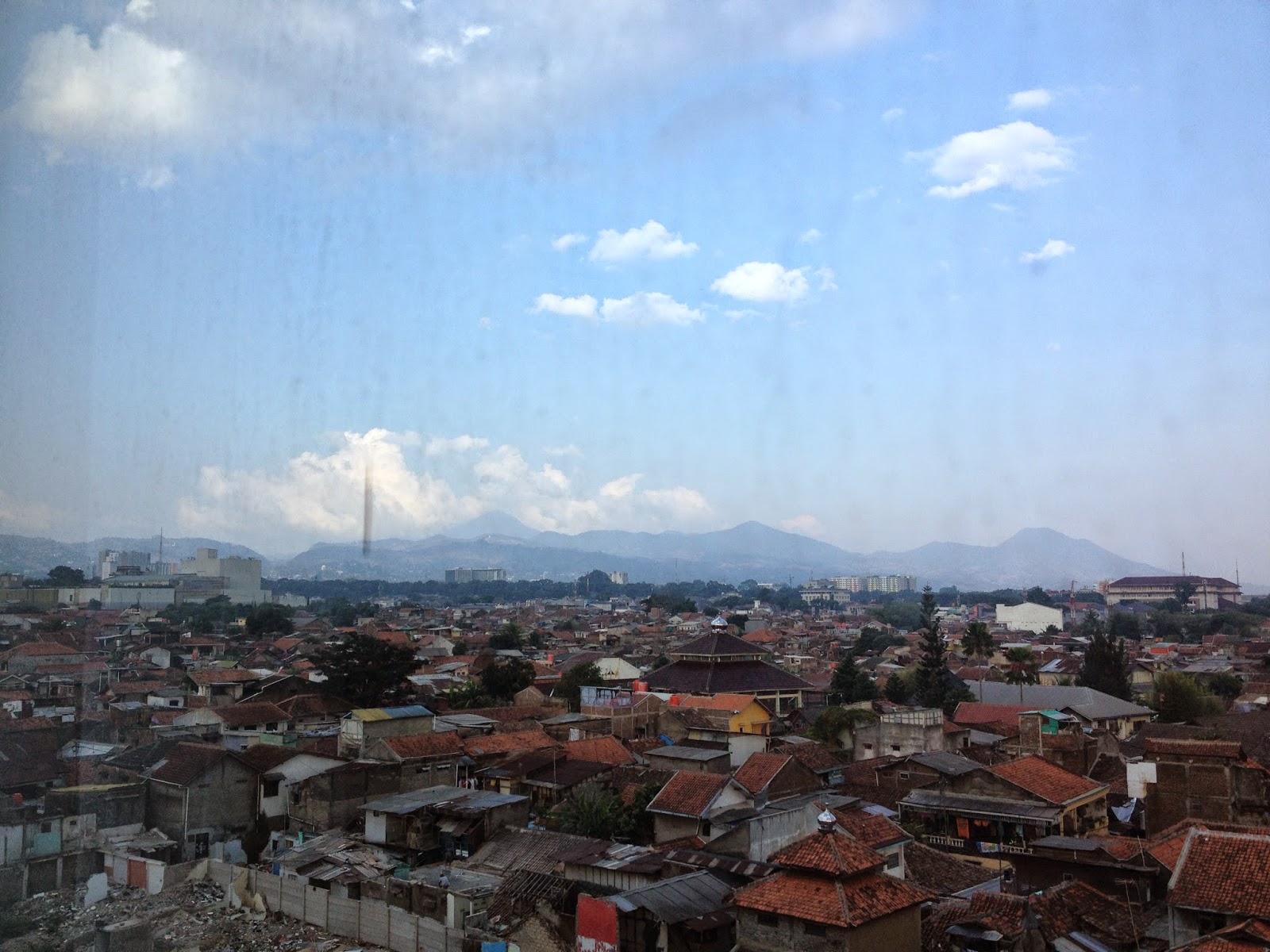
View over Bandung, West Java, with mountains in the background
These are hopeful times in Indonesia. The recent election by large margins of Joko Widodo, known as Jokowi, has given hope that some of the entrenched corruption and powerful interests that have dominated Indonesia in the past can be overcome. Jokowi did not arise from the Jakarta elite, but rather from a poor family in Central Java, before beginning a political career that made him governor of the capital city before assuming the presidency. He faces considerable opposition in parliament and outside of government to his reforms, but the Indonesians I interact with seem to be hopeful about the potential of this new administration.