Monday, February 4, 2013

Dining in Malta

Octopus Stew, cooked with peas, olives, tomatoes, and white wine

There is only so much one can do with institutional food. Cooking dinner for 500 or so, as the conference hotel where I am staying does, can only be seen in industrial terms. The decidedly Mediterranean-inspired buffets provide nourishment, yet everything - including the beautiful desserts - somehow falls a bit flat. 

I am thankful for a few opportunities to explore Maltese food outside the conference environment. I am told that the meat of choice for a Maltese feast is actually rabbit, with the head and "boney parts" stewed in a tomato sauce served with pasta as a first plate and the stewed rabbit meat served with roasted potatoes and vegetables as a second plate. The Italian influence in both content and style of serving is apparent. While English is spoken nearly everywhere on the island, Italian is unquestionably the language of food. 

Yet Maltese are quick to point out the unique aspects of Maltese cooking. While pasta is often offered as a first course, meat is usually served with potatoes. Seafood of every kind is plentiful - even if very expensive. Sea bass appears to be a nearly daily staple, along with beautiful bread, abundant olive oil, fresh goat cheeses (known as cheeselets, which I have had both spiced in olive oil and fried in crumbs), and the biggest capers I have ever seen. 

Dessert usually revolves around either fresh fruit (it is blood orange and grapefruit season) or something employing dates and/or figs. Even at this decidedly non-touristy time of the year, hawkers on the street sell various forms of nougat (a kind of fudge-like thing with nuts or other flavorings). Tiny cookies filled with figs and fried appear to be a breakfast staple. Numerous other sweet pastries are sold in small shops everywhere called pastizzerias with Italian-style small cups of coffee or cappuccino. 

A fig-filled fried crêpe
The few open fields of Malta are filled with vines, and the local wines are both white and red and very inexpensive. A meal without wine appears to be akin to an ocean without water.  Dinners are long and lingering.

Undoubtedly, I have merely scratched the surface of Maltese cooking. It is really amazing to me how much more most cultures around the world value food - be it China, India, Europe, or Latin America.  Food is an art form. Although the idea of "convenience foods" are spreading, there still seems to be a greater appreciation for the beauty of what food can be. Perhaps this is returning a bit in the United States, at least in certain quarters as local ingredients, seasonal dining, and home cooking become a bit more prevalent.  

Just one small anecdote to close. At a small restaurant near the hotel, a couple of colleagues and I have hosted several small dinners this week. The restaurant is small, no more than 10 tables. Only one waitress is not part of the family. The menu is enormous, filled with choices, yet it becomes clear very quickly that only items reliant on seasonal ingredients are available. When one of my fellow diners ordered a caprese salad (fresh mozzarella, tomatoes, and basil in olive oil), the waitress gave him the kind of look one gives a recent arrival from Mars. "How do you expect me to make you a decent caprese in January?" she asked incredulously...

Visiting summer holiday spots in January...

View from Valletta

I arrived in Malta in the throws of a fierce Mediterranean storm, the kind that I am told are not particularly unusual in January.  The cold winds howled at a clip great enough to nearly knock me off my feet as I made my way to a nearby drugstore to buy some toothpaste on Thursday evening.  Huge waves crashed into the sea wall, sending spray many feet into the air.  It was not a day for a pleasant stroll along the promenade.  

Even as the weather improved and I found enough free time between meetings to venture out, I was reminded that visiting a place like Malta in January is not ideal.  Many shops and restaurants close down for the month of January and others keep irregular hours, ready to close up early for the day if business is especially slow.  I found downtown Valletta nearly deserted on Sunday afternoon, with only a few of the tackiest tourist shops open. The silence was broken only by a vibrant celebration of the feast of St Paul's shipwreck outside the famous church of the same name. 

Mdina Cathedral
Valletta, the capital city of this tiny island nation, sits on a peninsula high up above the sea. The walls are, at times, nearly twenty stories in height, plunging down to the sea. The straight, Renaissance-era streets (this is the new capital, after all) are lined with shops, churches, coffee houses, and offices. From the gardens at peninsula's end, there is a fabulous view out over the seas and the surrounding communities. Sometimes it seems that even an ugly city - which Valletta is decidedly not - would appear beautiful under the golden light of the Mediterranean sun. There's just nothing quite like Mediterranean sunlight.  

The northern side of Malta is densely populated, with one village flowing into another (although I'm told that local communities have a fiercer-than-average local pride and identity). This gives way slightly as you head inland, where a few farms begin to appear in the sloping valleys. The ancient capital city, Mdina, is found high on a hill near the center of the island. An ancient fortress containing several Roman ruins and even more ancient burial sites, Mdina is a medieval beauty. Visiting her on a sunny Monday morning in January was perhaps an advantage. Although many shops were closed, I had the narrow streets mostly to myself.  Tranquility was a word that came frequently to my mind as I explore tiny alleys, ancient churches, and a few museums. These are the kinds of museums that were established to display the "stuff in the basement" of churches that includes everything from medieval liturgical books to early modern altarpieces. You never know what treasure might lurk behind the next corner in a place like this.
Seventeenth century altar painting of the nativity in Mdina Cathedral Museum
 The fine cathedral of Mdina, constructed after the great earthquake of 1693, engages all the senses with music, incense, and beautiful artwork, including "tombstones" of inlaid marble that cover the floor of the nave and the chapels, exulting in Latin long deceased bishops and archbishops, often depicting them as skeletons setting aside their earthly crown for a climb toward heaven. 

I am not sure I would recommend visiting Malta for a holiday in January. But it has certainly had its advantages in terms of tranquility.  

Artifacts

St. John's Co-Cathedral - Valletta, Malta

It is hard to travel in southern Europe or the Middle East without using the word "artifacts". The lands around the Mediterranean are abundant with remnants of millennia of human civilization, as are parts of India, China, and elsewhere. I remember being awed in my earliest travels by churches and Russian fortress walls that had endured from the 12th century or so in Moscow. The Mediterranean makes this look positively recent by comparison. This is as clear in Malta as anywhere, with the site of Paul's shipwreck from the book of Acts, numerous Roman ruins, and prehistoric temple remains dating back several thousand years before the Romans.  

Malta is a crossroads. A tiny island about 10 miles wide and 20 miles long, it is home to a rather densely packed 350,000 people. The architecture is in some ways definitionally southern European, with an abundance of baroque Catholic churches, grand villas, and sprawling piazzas. Yet in another way it has a deeply Middle Eastern feel, with many homes constructed in a manner you'd see in Jordan or Lebanon. Sitting almost at the middle of the Mediterranean, Malta has been a crossroads of cultures - Roman, Greek, Arab, Norman, British, and Italian, among others.  

This is visible even in the "artifacts" of language. While British English and to a lesser degree Italian are spoken nearly everywhere (Malta gained independence from Britain in 1964 and sits not far from the southern coast of Sicily), Maltese is used on most signs and is heard everywhere. Maltese is at first a disorienting language to bold in written form, with its numerous additional characters added to the Latin alphabet.  The language is Semitic, in the same family of languages as Arabic, Hebrew, and Amharic, though it is the only Semitic language to be written in the Latin script. 
A sample of Maltese and English
There are few architectural or other artifacts to recall that Malta was under Arab control for several centuries, as was its northern neighbor, Sicily. These artifacts of Muslim presence here have largely disappeared in the past few centuries. It is not dissimilar from the way in which Christian artifacts have mostly disappeared from areas that were once predominantly Christian - Algeria, Mesopotamia, Turkey, and to a lesser degree Central Asia and western China. In all of these places, once vital and numerous Christian communities died out, some over the course of centuries, while others disappeared more quickly, leaving in some places - such as Kyrgyzstan - only a few Christian tombstones written in Syriac script as physical reminders of this Christian presence.  

Times change. Things that seem permanent - even entire civilizations - pass away leaving only few artifacts in museums to remind us of what was most precious or most intimate to these people. It's a good reminder to those coming from the "young" side of the world that there's a lot of accreted experience in this world, and that it has much to teach us.  

My thinking on artifacts has been inspired in part by Philip Jenkins' The Lost History of Christianity, which is a good, readable-yet-grounded look at Asian and Middle Eastern Christianity - the "eastern half" of church history that is all too rarely told, but so very important.  Highly recommend.  

Sunday, October 21, 2012

Nations switching languages

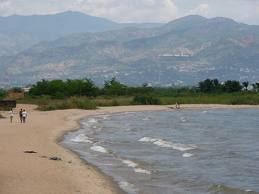
Bujumbura, Burundi viewed from the Lake Tanganyika Beaches

I’ve always thought of Rwanda as a Francophone country. While I’ve been aware of the Rwandan government’s attempts to begin to switch the language of higher education to English, I was not prepared for the overwhelming Anglicizing that has happened here. Driving through the streets of Kigali, French is likely the third most prominent language, following English (probably 80% of all signage) and Kinyarwanda, the national language. While walking through the market today, most people addressed me in English. This country is in the midst of a major linguistic (and geo-political) shift.

Rwanda (along with neighboring Burundi) is a linguistic oddity in Africa. Both nations are linguistically homogenous with only one national language – Kinyarwanda or Kirundi – which are themselves mutually intelligible. They lack the linguistic mosaic that characterizes nearly every other African nation. Both were German colonies in the late nineteenth century and then came under Belgian rule from World War I until the 1960s, entrenching French as the language of education. With the uneasy relationship between Rwanda and France following 1994, Rwanda has made a strong move toward Anglophone East Africa, going so far as to join the Commonwealth.

I struggle to think of another recent situation in the world where a country has quite literally switched its major educational language. Certainly in the aftermath of 1991, the former Soviet republics moved toward reclaiming their national languages. Yet this was a political change. The populations, for the most part, already spoke their languages and most of them had been used to some degree in education at some point in the Soviet Union. This is not the case with English for most of the Rwandan population. I’m told that university professors and secondary school teachers are teaching in English while still learning English. Certainly this creates a bit of national linguistic dissonance.

The situation in Burundi is much more complex. Although the city is much more “Francophone” on the surface (I saw very little English signage, even at the airport, more like Francophone West Africa), it is clear that the professional and educated classes are increasingly learning English. Several universities are teaching in English, although seemingly with a transition at a slower rate than Rwanda. While Burundi has joined the English-speaking East African Community, it clearly intends to keep one foot in the French world as well. Interestingly, I saw nothing written about “Afrique de l’est”. Rather, it was always “l’East Africa”.

Listening carefully to several indirect conversations today, it was clear that Rwandans and Burundians are not unused to linguistic mixing. The predominantly vernacular conversations were peppered with Swahili, English, and French phrases. This is yet another place where identity – and language as a key marker – is very complex. 

I'd say in closing that both Kigali and Bujumbura and their surroundings were among the most beautiful places I have visited in terms of topography. Bujumbura, in particular, with the drama of the Lake Tanganyika shore, the climbing hills to the west and the dramatic mountains of Congo to the east, is a very striking place. Kigali was a more bustling city than rather sleepy Bujumbura. Both are worthy of much more exploration. 

Friday, October 19, 2012

A few experiences


This has been a remarkably rich trip, and it is not over yet. Sometimes I have to make a list of experiences. I do love my job.

  • Interacted with 220+ people from 50+ nations at a consultation of theological educators.
  • Argued vigorously with a taxi driver that I was sure was overcharging me. Managed to get his boss to lower the price on the driver's cellphone. Then came to find out it was a very fair fare in the first place. Humbled. 
  • Gazed out at the wonder of a game park in the middle of a city (Nairobi National Park).
  • Spoke to 1,500 university students with three minutes' notice. 
  • Observed as same 1,500 university students listened to and interacted with a rather graphic sermon/testimony on sexual addiction (toward the top of my interesting and informative cultural experiences list).
  • Saw a plaque commemorating the visit of the church where I grew up in Ohio to a Kenyan university in 1997. 
  • While dining in the "Karibu Canteen" at said university, ended up with tripe stew for lunch by saying "I'll have what he's having" (it was quite tasty).
  • Observed what I can only describe as a rather remarkable personal transformation in a leader I've known for nearly 15 years. 
  • Watched several beautiful Kenyan sunsets while enjoying good conversations.
  • Met with an Archbishop who insisted that I call him by his first name, rather than "your Grace," as I was instructed to do. 
  • Was reminded that there are foods I don’t care for, namely liver.
  • Learned that Rwandan chai (spiced tea) is perhaps the best in the world (heavy on ginger)
  •  Ate one of the best omelettes of my life (one of the better legacies of Belgian colonialism).
  •  Met someone from Angola in person with whom I've had e-mail contact since 1998.
  • Was reminded that the Swahili word “karibu” has a much broader and deeper meaning than the English “welcome”.  
  •  Ended up with everything in my suitcase covered in glitter that rubbed off a gift.
  • Was left waiting at the airport in the middle of the night for the first time in my traveling life (for which I consider myself fortunate). Turns out I mixed European/African standard for expressing time (00.15) and American (12:15). He was planning to fetch me at noon; I arrived at midnight. All was well.
  • Was able to hear a lot of people leading innovation in education. Perhaps best of all, was able to encourage them. 
  • Was reminded once again how full of life Africa is. 


Thursday, October 18, 2012

Kigali

View of downtown Kigali 

This has been one of the most intense, exciting, exhausting, enlightening, and stimulating trips I’ve experienced in a long time. The sheer variety of enduring friendships and relationships at the ICETE consultation in Nairobi still rings in my mind. I am truly blessed to be relating to such interesting, gifted, creative people. 

I write from the Rwandan capital city, the “city of a thousand hills.” The French version of this name, la ville des mille collines, is a truly fitting descriptor of the city, which flows over hills and valleys, knit together by continuously curving roads. The downtown area sits high on one hill, the airport on another, and the diplomatic and administrative center on another. Like all African cities, it has a vibrant street life, yet the pace is distinctly less harried than Nairobi, Accra, or Lagos. If there is something that really strikes me about Kigali, it is its orderliness. This impression bases itself in the tree-lined avenues, the seemingly spotlessly clean streets and gutters, and the overall tidiness of the place.

I spent a couple of hours this afternoon – the first free hours I’ve had on this trip – wandering through a market district near my guest house on the edge of town. The streets were packed with tiny cell phone shops, a block of papeteries (the English “paper shop” just doesn’t capture this), hole-in-the-wall tea rooms and restaurants, tailors, and barber shops/beauty salons. I continue to be impressed with African sign shops as an art form. Some of them are truly spectacular. Africa – in all of its diversity – is so full of life.

A few months ago, I wrote from Khartoum how the words “the separation” (the 2011 split of South Sudan from the north) surfaced so frequently in conversation, reflecting a kind of mass wound to the national psyche. You can’t engage in too many conversations in Rwanda before the words “the genocide” enter in, reflecting a national psychic trauma that makes most others look like a paper cut. Only 18 years have passed since this country literally tore itself apart. The orderliness of Kigali today stands in stark contrast. But it’s here, lurking beneath the surface, and reminding us of our humanity. To make any further commentary upon this seems somewhere beyond trite. 

Friday, October 12, 2012

Growing used to airplanes


It is easy to get used to air travel. My (rather chatty) seatmate today on a Detroit-Amsterdam flight remarked how I was so engrossed in the article I was reading that I barely noticed takeoff (I’m still more aware of them than my airline-pilot’s-daughter-wife, who once slept through what remains the worst takeoff I’ve ever experienced). Routines become set. As so often happens, the abnormal (crossing an ocean in six hours) becomes normal.

Yet airline travel isn’t normal. It wasn’t that long ago that crossing an ocean was a once-in-a-lifetime event, a severance of ties on one continent to settle on another. Today, masses move back and forth. My neighbor’s today included a Polish-born engineer working with Chrysler in Detroit returning to Poland for a week’s visit to his mother. A clearly very wealthy Indian family was visiting relatives in Mumbai. An Iraqi Orthodox Christian woman was visiting her relatives in Jordan. These were just a few stories overheard in snippets of conversation. Yet each story – in and of itself – is rather extraordinary. Each of these stories would have been nearly unimaginable 30 years ago.

I still remember the first time I heard a family speaking Spanish among themselves in the local Rink’s discount store in Lima, Ohio circa 1980. Things foreign were unusual in that world. A bit startling even. Even there, however, globalization is real. The polyglot nature of a place like Amsterdam, where I write, reaches another level, where Europe, Africa, Asia, and the Americas collide and mix into a patois that is the new Dutch normal.

Again, the abnormal through most of human history (the extreme mixing of people in mega-cities) becomes normal. All indications are that we still stand near the beginning of an arc of the greatest wave of urbanization and globalization the world has ever known. The article in which I was engrossed during takeoff was about the transformation of the Indian city of Surat in the state of Gujarat. This city of 4.5 million today (India’s eighth most populous) is forecast to surpass 9 million by 2025, surpassing the populations of both London and New York proper. Some theorize that mega-cities like Delhi, Mumbai, and Shanghai could become the core of true megalopolises stretching for hundreds of miles and encompassing 50-60 million people. This is no longer the stuff of science fiction, but the emerging reality of Asia and beyond.  

I often wonder what the effects of these remarkable changes are on our human minds and hearts. We are remarkably adaptable creatures. Yet it seems to me that our natures are also change averse, at least in part. How fast of a clip of change can humans sustain emotionally, mentally, and spiritually? How do megalopolises of 60 million sustain themselves, both in physical terms but also in human terms? Change is happening so quickly in today’s world that we can become a bit immune, as I was reminded on my flight today. Sometimes, it seems to me, we need to step back from what seems normal and think about how abnormal it is. We need to contemplate what it might all mean.