Sunday, July 28, 2013

Being in Brazil

I am now at the closing end of a four-day trip to Brazil. Although I meant to spend the entire time in the Northeast of the country -- João Pessoa and Recife -- I ended up spending a full day in Brasília as well. 

Brazil is an immense country, almost a continent unto itself, with geography and population as varied as that of the US. At just shy of 200 million, Brazil trails only China, India, the US, and Indonesia. The distance from Belém in the far north to Porto Alegre in the far south is almost the same as the distance from New York to Los Angeles. The northeast of the country (Nordeste) is located on the big curve of Brazil/South America into the Atlantic Ocean. The population lives largely in a series of big and increasingly prosperous cities on or near the coast. The interior of the region is much dryer and is also the poorest part of Brazil -- a region known as the Sertão

The Northeast differs from the South in that the influence of later European and Asian immigrations (Portuguese, but also Italian, German, Dutch, Lebanese, Chinese, and Japanese) is much stronger in the southern states. The history of Brazil, in many ways, began in the Nordeste, and some of the oldest and finest monuments of Portuguese colonial times remain in this region. João Pessoa, Recife, and the neighboring city of Olinda all are filled with marvelous old churches and other monuments going back to the 16th century. Unfortunately, the brevity of my trip did not allow me to experience much of this side of the region. 

When I think of Brazil, several things come to mind immediately:

1.  Coffee - Brazil remains the world's number one coffee producer and few nations have seen their history so shaped by the crop. A meeting rarely occurs without coffee.  These are not the small-swimming-pool sized lattes and other such things that are common in the US (although you can find those here, too). Brazilian coffee is served strong, small, and sweet, in espresso-sized doses, often in tiny plastic cups. Whoever makes these plastic cups must have a very lucrative business! 

A typical Brazilian coffee
2.  Beaches - Although I haven't seen statistics on this, I would guess that a very high percentage of the Brazilian population lives within two hours of the Atlantic or Caribbean coast. Much of the coastline is beautiful sand beaches. Here in the Northeast, beachside hotels are full over the "winter" holidays. Both Recife and João Pessoa have miles of beautiful beach. While they do not compare in grandeur or pretense to the beaches of Rio de Janeiro, they are flocked with thousands enjoying the beautiful Atlantic. Unlike the North American Atlantic coast, which is subject to hurricanes, the Brazilian coast is tranquil. Unfortunately, the famous Boa Viagem beach here in Recife has in recent years been subject to shark attacks, and swimming is now forbidden. 

Boa Viagem Beach in Recife 
3.  Fruit - if there were a fruit olympics, where nations competed over the beauty and variety of their fruits, I would probably give Brazil the edge (with stiff competition from Indonesia). The sheer variety of fruits in Brazil is stunning, many of which do not even have non-Portuguese names. Almost anywhere you go, the list of fresh fruit juices is a lengthy one. These are indeed fresh juices, not the Tropicana idea of fresh, blended right before you drink them and often served in a small pitcher with a spoon for stirring. Most are served unsweetened in their natural state. I've sampled more than I can count in my visits to Brazil, ranging from the conventional mango, papaya, and guava to more exotic caja and maracujá  others whose names I do not recall). A trip to Brazil would be incomplete without sampling Guaraná, the most famous soda of the country, flavored with the guaraná fruit of the Amazon. 

The cajá or "hog plum," which is in season in Brazil (from Wikipedia)

4.  Food - Brazilian cuisine is varied and regional. Feijoada, a stew of black beans cooked with various kinds of meat, eaten with various vegetables and accompaniments, defines the cuisine of Minas Gerais and the Rio-São Paulo corridor. In the Northeast, beans are also plentiful, but are usually brown, more like black-eyed peas. Grilled meat -- churrasco -- is also popular across the country, and Brazilians have very specific tastes as to their favorite cuts of meat. Churrasco is incomplete without a good red wine, usually of Argentine or Chilean vintage, although the southernmost states of Brazil are producing increasingly respectable reds. Northeastern Brazilian cuisine makes heavy use of shrimp, other "fruits of the sea," and coconut milk. No visit to Brazil is complete with consuming an enormous quantity of pão de queiju, or cheese bread, made from tapioca flour and a white cheese. 

unloading coconuts in the early morning for sale on Recife beaches

Wednesday, July 24, 2013

Small towns that grow on you

When our family moved in 2012 from Indianapolis to Grand Rapids, we moved from the "Crossroads of America," where freeways and national highways radiated in every direction, to the last sizable city as you head north in Michigan. About 20 miles north of Grand Rapids, you notice a major change in the landscape. The fertile farms and hardwood forests that characterize southern Michigan (the "first four tiers") begin to give way to white pine forests over a blanket of ferns. The soils in these parts are less productive than in the south, so agriculture (excepting dairy) is not as important as it is in southern Michigan. There's no question that as you start to go "up north," things start to look very different. 

This becomes even more pronounced once you cross the breathtaking Straits of Mackinac and enter Michigan's Upper Peninsula. Although the eastern part of the UP has been connected to the lower peninsula since long before statehood in 1837, the western part of the UP that abuts Wisconsin and Minnesota was added as a consolation for Michigan's loss of a tiny strip of land that includes Toledo in the "Toledo War" of 1835-1836. (Yes indeed, the rivalry between Michigan and my native Ohio goes far back beyond football). The UP contains approximately 30% of the land area of Michigan, but only about 3% of its population. The largest town in the UP, Marquette, is just over 20,000 people. 

This was our first extended travel in the UP. We stayed in a tiny village called Grand Marais on the shores of Lake Superior. Grand Marais is, in many ways, a classic Michigan story of boom and bust. Originally plotted as a timber town, it grew to several thousand people and had its own railway in the 1890s. By 1910, however, the town had gone bust, and the railway came and ripped up the tracks to move them to Minnesota. The town only began to rebound through fishing in the 1920s when a road connected the town the main highway across the UP. Today, tourism forms the backbone of the economy. Although Grand Marais' history is decidedly less complex, the boom-and-bust cycle is not completely dissimilar from what has happened in Detroit (the city declared bankruptcy while we were in Grand Marais).

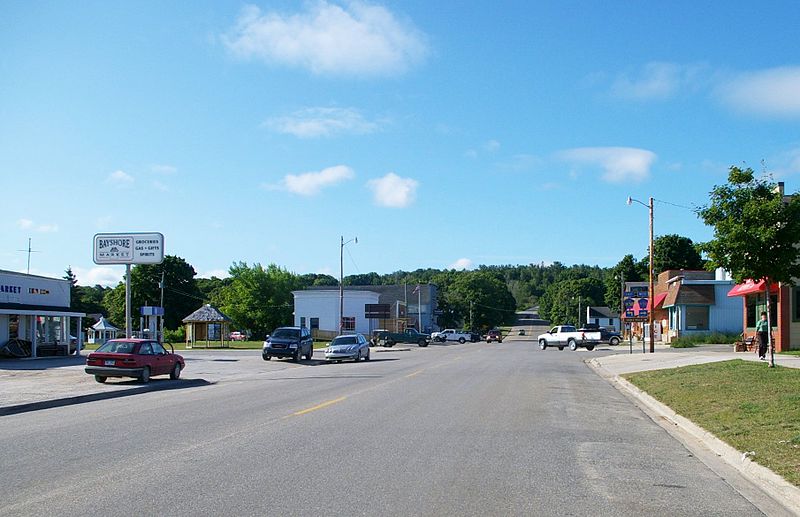
Downtown Grand Marais
It's hard to call Grand Marais "pretty," although it does sit rather dramatically on the pristine waters of Lake Superior. The town's downtown has three museums, a post office, a couple of small stores and shops, four restaurants, and a swimming beach on Grand Marais Bay. One of our first "learning curves" was the realization that anything resembling grocery shopping (beyond shopping at the gas station) required a drive of nearly 50 miles, one-way. Any more substantial shopping for clothes or shoes would have required nearly 100 miles one-way. 

On the shore of Superior - looking past the Grand Sable Dunes toward Grand Marais
Yet the town grew on us as we made it our base for exploring a stunningly beautiful region of the Superior Coast. It's the kind of place where they guy who runs the gas station will pull out his toolbox to do basic car repairs. It's the kind of place where people leave their doors unlocked and many things function on an "honor system." 

Perhaps our most interesting experience was walking to dinner at the West Bay Diner. The West Bay combines an early-20th-century frame home and a 1930-s era diner car in a mash up that, while not altogether architecturally appealing, certainly creates an interesting space. This is the kind of place where you dare not be in a hurry or come with a demanding spirit. Things are slow, informal, and clean-but-not-tidy. You just have to get used to the fact that they store their box of onions in the entryway. The story of the owners and the story of how they obtained a diner car from New Jersey is well worth reading. This was the only time I've ever been served by a waitress who is not only a published novelist but has also been published in the New York Times. A fascinating -- and very tasty -- experience. 

The West Bay Diner

It's a good reminder that we can't -- and shouldn't -- expect everywhere to be the same. Perhaps we'd all be a bit better off if we had to plan our grocery shopping a bit more carefully.

Expecting the Unexpected (aka an unplanned visit to Brasília)


As someone who travels a good bit and who is often around people who travel a good bit, I often hear "travel trauma tales." As I listen to these, usually with considerable sympathy, I often find myself being inwardly thankful that, for the most part, my travels have been mostly without incident. Perhaps my run of luck came to an end yesterday, as my still-in-progress trip to Northeast Brazil has not gone well so far. I will spare the "travel trauma tale," however. It's really not all that traumatic in the grand scheme of things. Instead, I'll focus on the unexpected chance to explore Brazil's capital, Brasília. 

Brasília, so I am told, is the largest city in the world that did not exist in 1900. It was built from scratch in the 1950s and became Brazil's capital city in 1960. Somewhat like L'Enfant's Washington, DC a century-and-a-half earlier, it was a wholly new city, designed on a grid. Brasília reminds me quite a bit of Washington, DC, albeit with mid-century-modern replacing the Greco-Roman-revival motif. 

Row of Ministries, with Parliament in the background - for a better photo look here
The movement of the capital from Rio de Janeiro in 1960 was something that had been in the works for more than a century, as numerous rulers of Brazil sought a capital city that was more centrally located and away from the established power structures and influences of the Rio-São Paulo corridor in the southeast. The new capital was also meant to make a strong political statement about the progress and potential of mid-20th-century Brazil. Designed by urban planner Lucio Costas and architect Oscar Niemeyer, the city is designed for both dramatic space and economic functionality. The division of the city into sectors (an embassy sector, a hotel sector, a business sector) take place on a giant grid. These areas are connected by wide, grand avenues and large green spaces. 

The National Museum with Ministries in the backgroud
The "Square of the Three Powers" (executive, legislative, and judicial) forms the heart of Brasilia, sitting at the end of a several-miles-long esplanade not completely dissimilar from the National Mall in Washington. But unlike the variety of buildings of various eras that line the Washington Mall, the first mile or so of the Brasília Esplanade is lined with identical buildings housing various ministries of the government. A large lake abuts this area, creating some fantastic water views. 

The far end of the Esplanade is anchored by a very 20th-century monument, the television tower. As in so many cities, a dramatic television tower was a powerful statement about the government's ability to speak to its citizens in a single idiom and with a common, centralized culture. The tower is surrounded by some lovely fountains today. 

The television tower at sunset
Perhaps the most dramatic buildings on the Esplanade are the Parliament building and the Cathedral. The Parliament consists of two connected towers (not dissimilar from the UN building in New York), together with a "dome" and a "bowl," each housing a house of the Brazilian Parliament. 

The Congress (from Wikipedia)
Although Brasília lacks the beautiful artistry of colonial-era churches so common in most smaller Brazilian cities, its modern religious architecture is among the best I've seen. The Cathedral, which stands on the side of the Esplanade, resembles a crown (it also reminds me of a standing rib roast, but that's not nearly as spiritual). The building is mostly glass, with the main sanctuary about one floor underground, accessed by subterranean entrances. The effect is quite dramatic as the light shines through the stained-glass walls into the sparse interior. It seems to capture in a very apt way the spirit of mid-20th-century Christianity much as the Sacré Coeur in Paris captures the spirit of Christianity fifty years prior. The Dom Bosco Sanctuary, located just outside of the downtown area, is another architectural treasure of floor-to-ceiling stained glass, kind of a mid-century-modern version of the Sainte Chapelle. 

The Cathedral and Belltower

At nearly 3 million, Brasília is Brazil's fourth largest city and represents the fifth largest economic unit in Latin America (many large Brazilian companies are based here). The city lacks the sense of rootedness that many older cities have, even when much of their architectural history has faded away. It certainly lacks the throbbing pulse that makes São Paulo so very frenetic. And it lacks the stunning visual background that Guanabara Bay gives to Rio de Janeiro. It does not have the "global city" feel of the capital cities of other emerging economies -- Beijing, Delhi, Moscow, Mexico City, etc. Yet more than most cities, it captures the essence of a moment of time, a hopeful, progressive moment that seems a bit naive from today's perspective. As Brazil continues to step up on the world stage, I have no doubt that its capital will step with it. Yet it will continue to remind of another Brazil in another time. 

The Cathedral - Interior


Thursday, June 13, 2013

Cities and Mountains

It's been a while since I traveled in Latin America. I'm remedying that to a certain degree over the next couple of days in Monterrey in northeastern Mexico. 

My first memory of Latin America was descending into the São Paulo airport in the early evening over the low mountains that surround the city, marveling at the clusters of favellas that stretch up the hillsides. Since then, I've come to appreciate the ways in which urban areas and mountains seem to collide in so much of Latin America. Bogota and Medellín, Colombia; Santiago, Chile, São Paulo and Rio de Janeiro, Brazil; Guatemala City, and Quito, Ecuador all come immediately to mind. Perhaps I've simply missed similar landscapes in other regions, but I think that there is something about this admixture in Central and South America. 

Cerro de la Silla (from Wikipedia)
Monterrey is another one of those cities. It is dominated by soaring sierras, with the city clustering along a valley and up the hillsides. The most impressive is the Cerro de la Silla (Saddle Mountain). The home where I am staying sits on one of those hillsides with a rather spectacular view of the mountains and the skyscrapers downtown. This afternoon, as we drove from town up the hill, one of these soaring mountains was draped with a cloud-tablecloth not unlike what I've seen in Cape Town (ok, so there's a non-Latin American city that has an incontestable urban-mountain mash up). Stunning. 

Monterrey is a bustling, orderly city, Mexico's third largest. It has long been known as a center of business and innovation, strategically placed on the trade routes between Texas and Mexico City. You see this in the soaring skyscrapers of company headquarters (some of the country's largest companies are headquartered here). You also see it in some of the beautiful public art, including a large factory complex that has been very artfully turned into a sprawling public park with a broad artificial canal. The old downtown -- the barrio antigua -- is filled with a grid of narrow streets with low-slung buildings, markets, and churches. Some of the oldest Protestant churches in Mexico are located in Monterrey, including the Baptist church, which dates to 1864. 


The view from my room 

This is only my third visit to Mexico, and all of my visits have been short. Yet I continue to sense that this country, perhaps simply due to its proximity, is one of the most misunderstood. While I think that there's a growing disconnect between what I hear in US news and what I see in the rest of the world, this contrast seems especially stark in Mexico. This is the kind of vast, complex, diverse country that you could devote a life to, and still walk away befuddled. 

Wednesday, June 12, 2013

Dining in Monterrey

In recent years, the authentic taco, with its soft, warm corn shell, some meat filling, garnish of crunchy vegetables, and sauce, has become more common in the United States. I recently had a taco from a food truck in Grand Rapids that rivaled anything I've had in Mexico. Granted, that particular memorable taco was Korean-themed and garnished with homemade kimchi, but it still had the soft, bitey wonderfulness that characterizes a genuine taco, albeit a bit globalized. And speaking of globalization, I do still have a soft spot for those North American hard-shelled tacos with red sauce, enjoying them as a culinary tradition all their own…

A real Mexican chips-and-salsa
There is no escaping the tortilla at the center of Mexican cuisine. Made of corn masa or wheat flour, they appear at most every meal in some form. The dining table is always graced by at least a couple of kinds of salsa as well, generally freshly made and of varying spiciness. 

My lunch yesterday was in a decades-old large restaurant in the center of Monterrey that prides itself on having been open continuously for 50 years (it is open 24/7). After convincing my hosts that I really do eat spicy food, I ordered enchiladas en mole. This dish is composed of chicken wrapped in tortillas, smothered in a thick and spicy brown sauce. While there are more recipes for mole than stars in the sky, most brown moles seem to share a kind of spicy denseness that comes in some recipes from the combination of several kinds of ground, dried chiles and a bit of chocolate. In reality, this particular mole was not all that spicy (or, to be honest, all that tasty). 

Cobrito - on the right side
One of the local specialties in Monterrey is a dish called cabrito. Cabrito means, literally, baby goat. Cabrito must be prepared from a goat less than three years old, which is the age when most goats begin to eat grass (or so I am told!). The meat is smoked and served with tortillas, fresh onions, tomatoes, lettuce, and chiles, cooked onions, and a variety of sauces. Pieces are wrapped up in a tortilla. While I am not certain that I'd add it to my daily diet (largely because I struggle with the idea of eating baby animals), it was a mighty tasty piece of meat. 

Perhaps the most interesting aspect of this dish is its historical origins in Jewish (!) cooking. Prior to the Inquisition in Spain, Jews composed a sizable minority. A few of these came to New Spain, including several prominent families that came to Nuevo Léon in the late 16th century. Although Judaism was banned in the Spanish Empire by this time, a number of these families remained "crypto-Jews" for centuries, secretly practicing the faith of their ancestors. This has apparently influenced the cuisine of Nuevo Léon, in both the presence of cabrito and the absence of pork from most local cooking. 


Few things testify more to globalization than food, whether Jewish-inspired smoked goat in northeast Mexico or Korean-themed tacos in Grand Rapids.

Friday, May 31, 2013

Dining in Bénin


Food is always a bit confusing to me when I travel in West Africa. Although there is quite a bit of similarity across the region in culinary terms, the terminology differs from place to place. The base is some kind of starch -- rice, various forms of cassava, corn meal, various forms of yams, potatoes, bananas, etc. -- served with some sort of stew (often made of a wide variety of greens), perhaps grilled or fried chicken or fish, and hot pepper sauce (piment) as a condiment. 

Benin is no exception. I've experienced several variations on the West African theme, including a very tasty stew made from friend cheese (not unlike Indian paneer) stewed together with a very bitey green leaf, tomatoes, and onions. Fried and stewed fish are common, given the oceanfront nature of Cotonou. Yet I'm told that the quintessential Cotonou meal is based on a cornmeal cooked until thick with tomatoes, peppers, and other seasonings (amiwo) , served with a savory stew of onions and tomatoes, and fish or chicken, with a bit of piment on the side. A variety of western soft drinks are available, yet something called "youki" which involves fresh grapefruit juice and carbonation, seems a common choice. 

Pounded yams with fish stew
At another meal, I chose a fish stew in a red sauce served with pounded yam, what is called fufu in Ghana. This dish is eaten by taking bits of the starch in your fingers and using it to scoop up the fish and sauce. It's one of my favorites, and is quite difficult to find in the US. 

Chicken with amiwo and stew
Dessert is fruit -- the bounties of a tropical land -- mangoes, pineapple, oranges, grapefruit, bananas of all shapes and sizes, watermelon. This is the height of mango season, and you see people selling mangoes all over the city. At one point, I saw them being sold from the back of a dump truck. While some resemble the kinds of mangos we find in a US supermarket (small and light yellow or variegated green, orange, and red), others are like nothing I've seen elsewhere. Some of them are nearly the size of a football and must way 5 pounds. For a mango lover, this is like a window into heaven…

Timmy Tiger with a Bénin mango 

The Elephant in the Room


You can't spend much time in coastal West Africa without being reminded about the issue of slavery. This is especially true in Bénin. I read in several places here that 40% of the slaves that were part of the Atlantic slave trade in the late 17th-early 19th century came from what is now Bénin, through a series of agreements between the local rulers of the Dahomey kingdom and the Portuguese, French, Dutch, Danish, and British traders who traded on the coast near the city of Ouidah. The predominance of slaves from this part of Africa was critical in the development of voodoo (which derives from the Fon word for god or deity) in Brazil, Haiti, and Cuba. 

I had a chance today to visit the city of Ouidah, a sleepy little place between Cotonou and the Togolese border. Ouidah is filled with architectural remnants of the 18th and 19th centuries. A Portuguese trading fort is well preserved and serves as a local museum, chronicling the history of the slave trade, the Kingdom of Dahomey, and the Dahomey diaspora spread across the western hemisphere by the slave trade. 

Memorial on the ocean front at Ouidah
Ouidah sits several miles north of the ocean. On the south side of the town is a large square that once served as the city's slave market. Traders would come here to inspect the "wares". After contracts were sealed, the slaves were then chained together and forced to walk to the coast, where they were crammed into ships and sent around the West African coast to the Ile de Goré in Senegal, where most transatlantic voyages commenced. 

Today, a large monument stands overlooking the ocean, serving as a monument to those who passed this "point of no return." The slave trade during the Dahomey period remains a live political issue today, as some in the country's north continue to resent the fact that the Dahomey kings were very much complicit in the slave trade that took place 200 years ago. 

Museum of Ouidah - an old Portuguese fort
Aside from these sad reminders of human history, Ouidah is a beautiful place to visit, with a quiet culture far removed from the bustle and dust of Cotonou. I am thankful for these opportunities to visit places a bit off the beaten path.